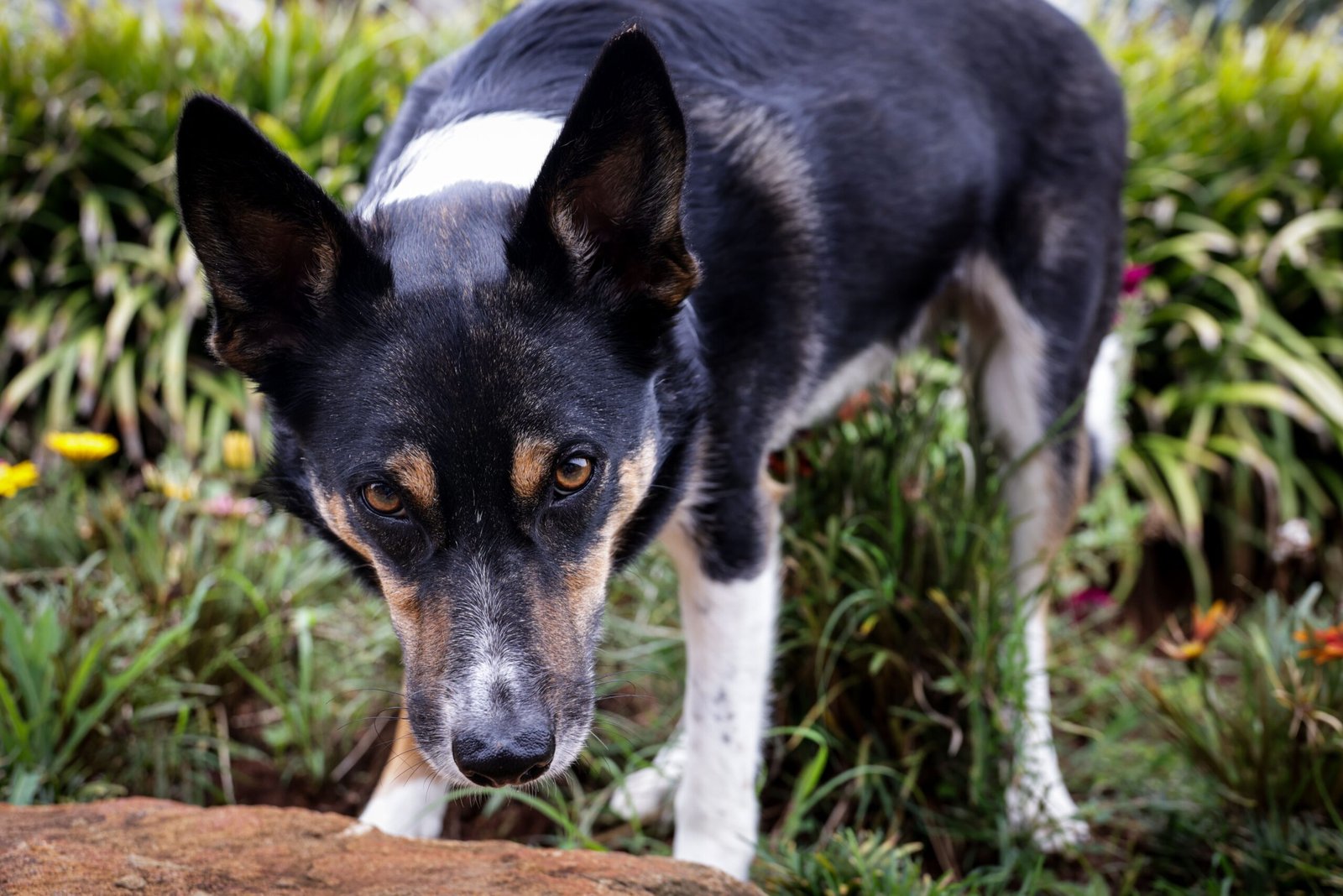
Dogs bark, whine, and howl — but those are a tiny fraction of how they communicate. The rest happens in the body: the set of the ears, the height of the tail, the tension around the mouth, how the weight is distributed across four paws.
Once you learn to read it, a lot of “sudden” behavior stops being sudden. The dog who “bit out of nowhere” was usually signalling discomfort for a full minute first. Nobody was reading.
Here’s the vocabulary.
The Tail: Direction and Speed Both Matter
A wagging tail does not automatically mean a happy dog. It means arousal — which can be joy, but can also be tension or uncertainty.
What to read:
Height. A tail held high and stiff signals alertness or confidence, sometimes a challenge. A tail at the natural mid-level means relaxed. A tail tucked low or between the legs means fear or appeasement.
Speed. Broad, loose sweeps that move the whole rear end are the friendly wag. Fast, tight, twitchy wagging at a high tail position is closer to “I am very stimulated and could go either way.”
Direction. Research has found dogs wag slightly more to their right side when they see something they like, and to the left when facing something they’re unsure about. Hard to spot in real time, but it’s real.
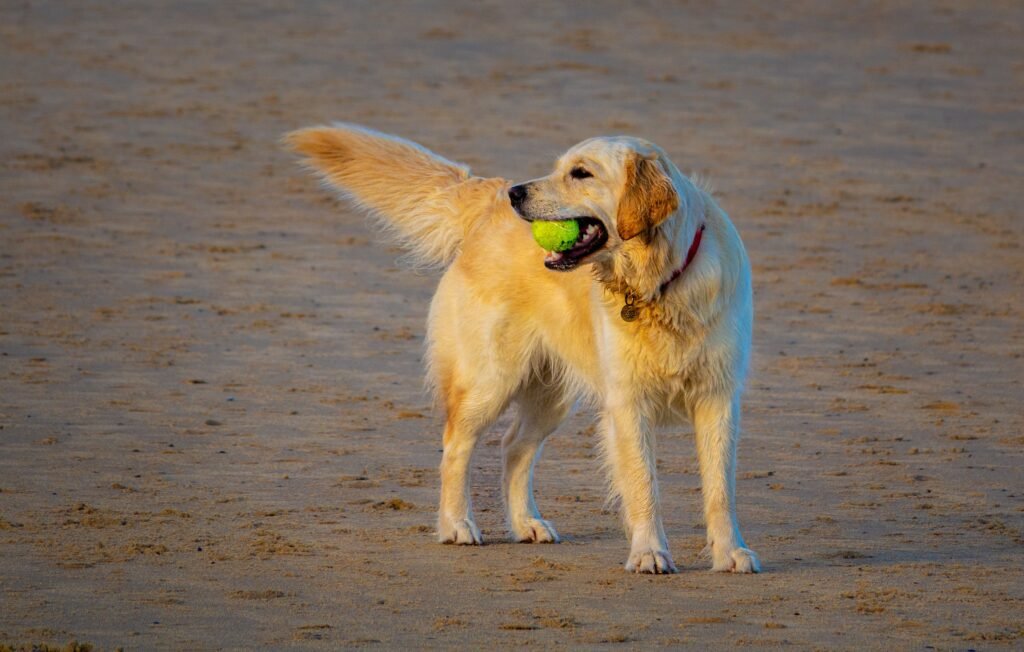
The Ears: Where Is the Attention Pointed?
Ears are the easiest signal to read once you know the dog’s neutral position — which varies enormously by breed, so learn your dog’s baseline first.
- Forward and up — interest, focus, sometimes challenge
- Neutral, relaxed — calm
- Pinned back flat — fear, stress, or appeasement
- One forward, one back — genuinely torn attention, often mild uncertainty
A floppy-eared dog still moves the ear base. Watch where the base pivots, not the flap.
The Eyes: Soft, Hard, and Whale Eye
Soft eyes — relaxed lids, blinking normally, gaze that comes and goes. A comfortable dog.
Hard stare — fixed, unblinking, whole body still behind it. This is a warning. Most dogs give it well before anything escalates.
Whale eye — the dog turns their head away but keeps their eyes on the thing, showing a crescent of white sclera. This is one of the most under-recognized stress signals in dogs, and it shows up constantly in photos of children hugging dogs. If you see whale eye, the dog wants out of the situation.
The Mouth: Tension Tells You More Than Teeth
A relaxed dog has a loose, slightly open mouth, sometimes with the tongue lolling. Tension shows as a closed mouth with tight lips pulled forward, or a “long lip” pulled back at the corners.
Some dogs show a “submissive grin” — front teeth exposed with a wrinkled muzzle but a loose, wiggly body. It looks alarming and means the opposite of a snarl. Read the whole body, not the teeth alone.
The Calming Signals Almost Everyone Misses
These are the small behaviors dogs use to defuse tension — with other dogs and with us. In isolation each is meaningless. Repeated, or clustered, they say “I’m uncomfortable, please give me space.”
- Yawning when the dog isn’t tired
- Lip licking when there’s no food around
- Turning the head away from a person or dog approaching
- Sniffing the ground suddenly in a tense moment
- Shaking off as if wet, when completely dry
- Slow, deliberate movement where the dog would normally be quick
The single most useful skill in this whole article is noticing these. They are your dog’s polite request, and they come long before a growl.
Whole-Body Postures
Play bow — front end down, rear end up, tail wagging loosely. Universal dog for “everything after this is a game.”
Freeze — all movement stops, body goes rigid. This is serious. A freeze often comes immediately before a snap. Give space, don’t reach in.
Weight forward — leaning toward something, up on toes. Confidence or challenge.
Weight back, low body — moving away from something, wanting distance.
Belly exposed — can be a relaxed dog inviting a belly rub, or an anxious dog appeasing. The difference is in the rest of the body: loose and wiggly means “rub me,” stiff with a tucked tail and turned-away head means “please stop.”

Read Clusters, Not Single Signals
No single signal means anything on its own. A wagging tail on a stiff body with a hard stare is not a friendly dog. A dog showing teeth with a loose wiggling body is not a threatening dog.
Read three things at once — tail, ears, mouth — and check whether the body is loose or stiff. Loose almost always means fine. Stiff almost always means take it seriously.
The Five-Second Read
When you need an answer fast — a strange dog approaching on the pavement, your own dog in a situation you’re unsure about — you don’t have time to inventory every signal. Run this instead, top to bottom, and stop as soon as you have your answer.
- Is the body loose or stiff? This one question answers most of it. Loose curves and easy movement mean the dog is fine. Straight lines and stillness mean they aren’t.
- Where is the weight? Forward and up on the toes is confidence or challenge. Back and low is a dog wanting distance.
- Is the mouth open or shut? A loose open mouth is a relaxed dog. A mouth that closes as you approach is the first sign of tension.
- Where are the eyes? Soft and moving is fine. Fixed and unblinking is a warning.
- Is anything repeating? Three yawns in a minute, repeated lip licks, a dog who keeps turning away — repetition is the volume knob on a quiet signal.
If the answers are loose, neutral, open, soft, and nothing repeating, you have a comfortable dog. Any two of the opposites and you should give the dog more space, not less.
What Dogs Say to Each Other
Most of this vocabulary wasn’t developed for us. It’s how dogs negotiate with other dogs, and watching two dogs meet is the fastest way to learn it.
The curve. Confident, socially fluent dogs approach each other in an arc, not a straight line. A dog marching head-on at another dog is being rude in dog terms, and the other dog knows it. This is also why on-leash greetings go wrong so often — the leash forces a straight-line approach that neither dog would have chosen.
The sniff order. Rear-end sniffing first, faces later, is the polite sequence. A dog who goes straight for the face is pushing.
The split. A dog who walks between two others who are getting tense is doing something called splitting — physically interrupting to lower the temperature. Some dogs do it to their owners during an argument.
The play interruption. Healthy play has pauses. Dogs break off, shake, sniff the ground, then re-engage. Play that runs and runs with no pauses is escalating, and it’s worth calling both dogs out for a moment before it tips over.
Once you can see these between dogs, you start noticing your dog using the same gestures on you — because they are.
Three Situations People Read Backwards
The hug. Dogs don’t hug. Being wrapped by the shoulders restricts movement, which is the opposite of what a worried animal wants. Watch a photo of someone hugging a dog and look for whale eye, a closed mouth, or a head turned away — you’ll find it far more often than you’d like. Some dogs genuinely enjoy it; most tolerate it.
The “guilty” face. The flattened ears, the lowered head, the eyes sliding away — this is not guilt about the chewed shoe. Dogs don’t connect a telling-off to something they did an hour ago. What they’re reading is your body language right now: your posture, your voice, your stare. The guilty look is an appeasement display aimed at you.
The growl. A growl feels like the problem. It’s actually the solution — a dog telling you clearly that they need something to stop, without touching you. Punishing a growl doesn’t remove the discomfort, it removes the warning.
Why This Matters
Dogs escalate in order: they signal quietly, then more obviously, then they growl, then they snap. Every step is a request. When people punish the growl — the most honest warning a dog can give — some dogs learn to skip it, and go straight from silent discomfort to teeth.
Learning the quiet signals means your dog never has to shout.