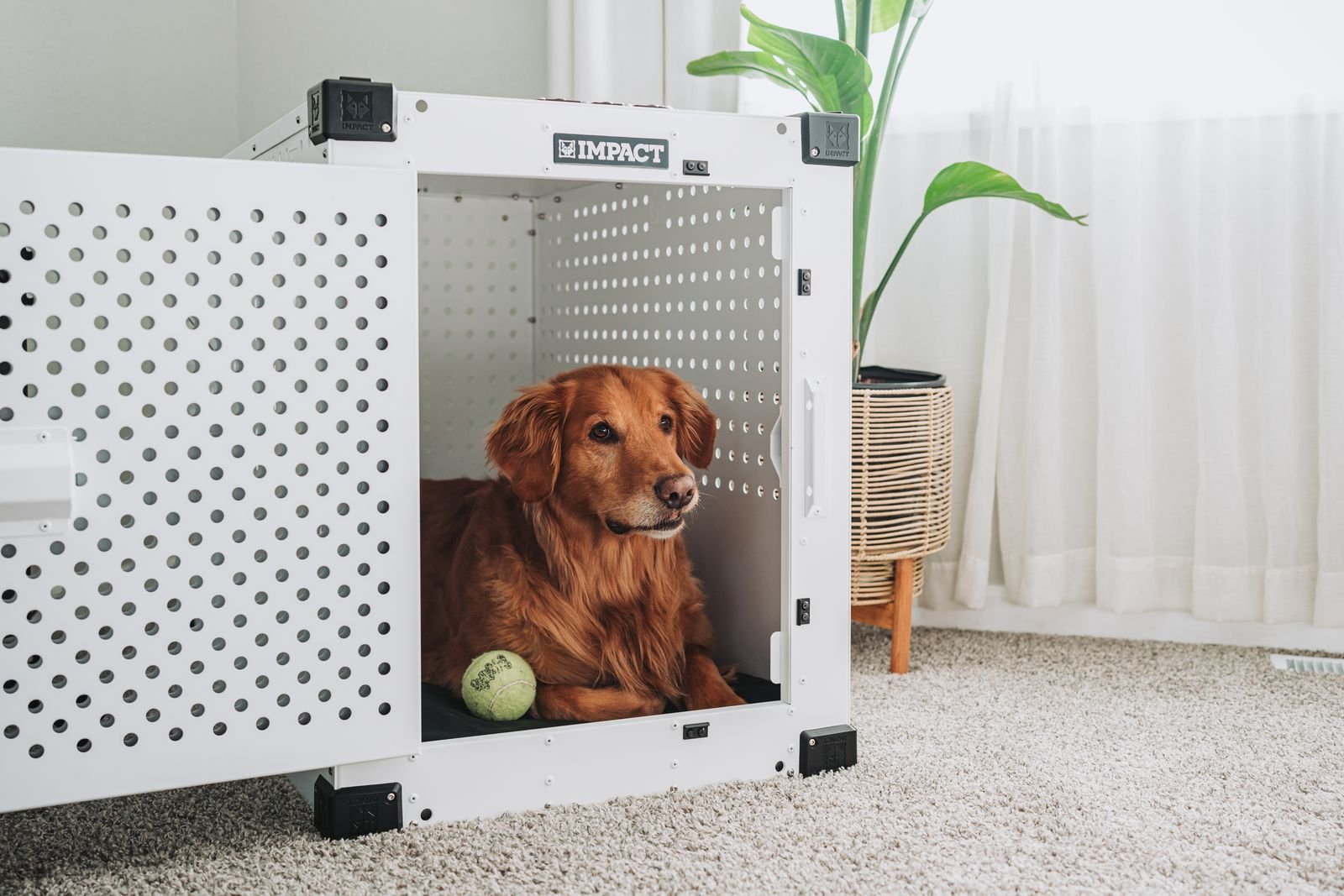
The Cage Is in Your Head, Not Your Dog’s
Almost everyone feels a twinge the first time they snap a crate together. It has bars. It has a latch. You just spent real money on something that looks like it belongs in a shelter.
Take the twinge seriously for about ten seconds, then let it go. Dogs are not claustrophobic the way people are. Left to their own devices, most of them choose the smallest sensible spot in the house — under the coffee table, behind the couch, the footwell beneath your desk. Enclosed space reads as safe to a dog, not trapped. A crate is essentially a door on a room your dog would have invented anyway.
What turns a crate into a cage is never the bars. It is how it gets used: too fast, too long, or as a consequence. Done right, it becomes the one address in your home where nobody bothers your dog — not the vacuum, not the toddler, not the houseguest who is certain every dog enjoys a hug.
One honest caveat: a small share of dogs never settle in a crate, and a dog with genuine separation anxiety can panic in one. If yours is drooling heavily, bending the frame, or hurting himself, stop and talk to your vet rather than pushing through. For most dogs, though, the reluctance in the room belongs to the human.
Big Enough for a Bedroom, Not an Apartment
Sizing is where good intentions do the most damage, because the instinct is to buy roomy. A crate should be just big enough for your dog to:
- Stand up without ducking his head
- Turn around in one smooth motion
- Lie down stretched out on his side without pressing into the walls
That is the whole spec. Go much larger and you have not given him a suite — you have given him two rooms, and dogs are tidy enough to sleep in one and use the far corner for everything else. Housetraining stalls, and it looks like stubbornness when it is really floor plan.
For a puppy, buy the crate that fits the adult dog he will be and use the divider panel most models include, sliding it back as he grows. Cheaper than buying three crates, and the space stays honest at every stage.
The Slow Way In
The whole method is food, patience, and an open door — in that order.
Start with the door latched open so it cannot swing shut and startle him. Toss treats near it, then just inside, then at the back, letting him walk in and out with no comment from you. Feed his meals in there, bowl at the back. Nothing closes. Nothing happens. The crate is simply where good things live.
Once he strolls in without hesitating, close the door for a few seconds while he eats and open it before he finishes. Then a little longer. Then long enough that you can sit across the room, then long enough to walk to the kitchen. If he starts scanning for you, you moved faster than he did — back up a stage.
A stuffed chew toy, frozen the night before, does more of this work than any amount of coaxing. And crate him sometimes while you are home, so the closing door never becomes a reliable signal that you are leaving.
Two Things That Poison a Crate for Good
The first is using it as punishment. Send him there after he shreds a shoe and you have taught him the crate is where bad afternoons end. Dogs are excellent at that arithmetic. The crate has to stay neutral, or better than neutral, every single time.
The second is opening the door mid-complaint. A dog who whines for two minutes and gets released has just learned exactly how long to whine. Wait for a pause — even a couple of seconds of quiet — and open on that instead. The exception is a real bathroom request, which usually comes after a long stretch or a big drink. Take him out on a leash, straight to the yard, no play, straight back. Boring is the point.
Keep daytime stretches reasonable, too. No adult dog should spend a full working day shut in, and puppies need out far more often than that.
Get it right and one afternoon you will notice your dog has taken himself to bed without being asked, door standing wide open, entirely his own idea.