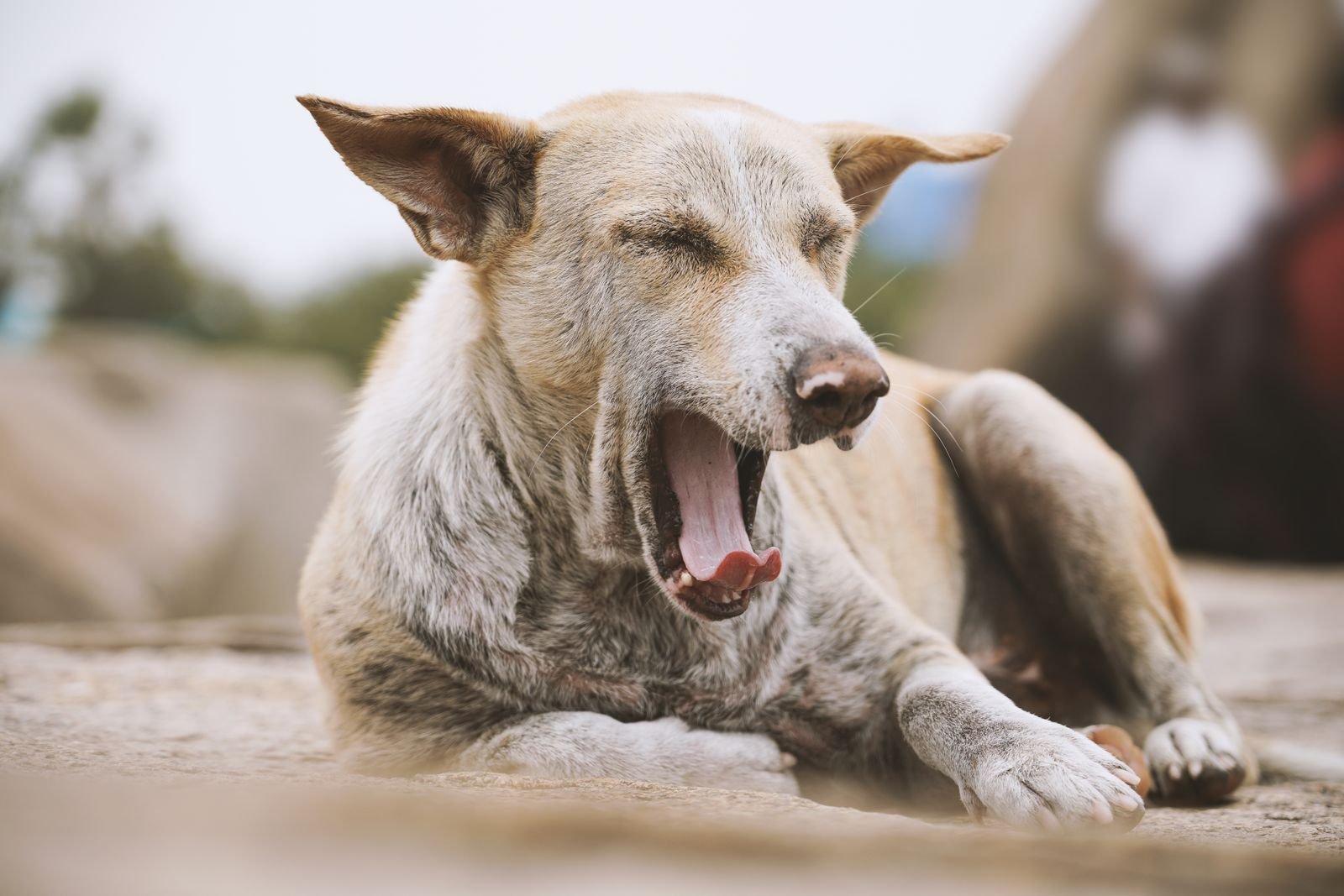
If your dog yawns when they’re clearly wide awake — at the vet’s office, when a stranger leans over them, right before you leave the house — that yawn isn’t tiredness. It’s communication.
Behaviorists call these calming signals: small, easily missed gestures dogs use to lower tension in a situation. Yawning is one of the most common.
The Three Main Reasons
Stress or discomfort. This is the big one. A dog who yawns during a nail trim, in a crowded place, or while a child hugs them is telling you they’re uneasy. The yawn releases a little tension and, in dog language, signals to whoever is nearby that they mean no harm.
Anticipation and excitement. Dogs also yawn when they’re keyed up in a good way — waiting by the door for a walk, watching you pick up the leash. The nervous system is stirred up; the yawn is a release valve.
Ordinary tiredness. Sometimes a yawn is just a yawn. Context tells you which: a yawn on the couch at 10pm is different from a yawn at the vet.
The Contagious Part
Dogs catch yawns from humans. Studies have found dogs yawn in response to their owner’s yawn more often than to a stranger’s — which researchers connect to social bonding and possibly a basic form of empathy.
Try it sometime. Yawn at your dog and watch.
Where You’ll See It Most
Once you know a yawn can be a stress signal, certain moments start standing out. These are the most common:
- At the vet, or in the car on the way there. Often the clearest example most owners will ever see.
- When a stranger leans over them. Leaning over a dog’s head is one of the most uncomfortable things a person can do to a dog they’ve just met. Crouching sideways instead removes almost all of it.
- During grooming or nail trims. Especially the first few seconds after you pick up a paw.
- While being hugged, particularly by children. Worth watching carefully, because this is where a missed signal matters most.
- In training, when the exercise is too hard. A dog yawning mid-session is usually confused or over-faced, not stubborn. Make the task easier and the yawning stops.
- When two dogs meet. A yawn here is often aimed at the other dog — a deliberate “I’m not a threat.”
How to Read It in Context
Look at what else the body is doing at the same time:
- Yawn + lip licking + turning the head away → stress signals stacking up, the dog wants space
- Yawn + loose wiggly body + tail sweeping → excitement, probably about something good
- Yawn + slow blink + settling down → actually tired
The signals matter as a cluster, not one at a time. Yawning is one entry in a much larger vocabulary — our full guide to dog body language covers the tail, ears, eyes, and posture together.
Do Puppies Yawn More?
Yes, and for both reasons at once. Puppies sleep a great deal, so plenty of their yawns are simple tiredness. But they also spend their first months meeting things they have no reference for — vacuum cleaners, staircases, other dogs, visitors — and a young dog with no experience to draw on hits the limit of what they can handle quickly.
A yawning puppy in a new place is usually a puppy who has had enough. The useful response is to end the outing early rather than push for one more minute. Puppies who get taken out of situations before they tip over grow into dogs who trust that their signals work.
When to Talk to Your Vet
Yawning itself is almost never a medical problem. But call your vet if you notice:
- A sudden, marked increase in yawning with no change in routine
- Yawning alongside drooling, pawing at the mouth, or difficulty eating — this can point to dental pain or nausea
- Yawning paired with lethargy or other changes in behavior
As always, the yawn isn’t the concern. The change is.
What to Do About Stress Yawns
Don’t scold and don’t push through. If your dog yawns repeatedly in a situation, they’re asking for space — give it to them. Move them somewhere quieter, end the interaction, or lower the intensity.
Dogs who get listened to at the quiet-signal stage rarely need to escalate. That’s the whole point of learning to read them.