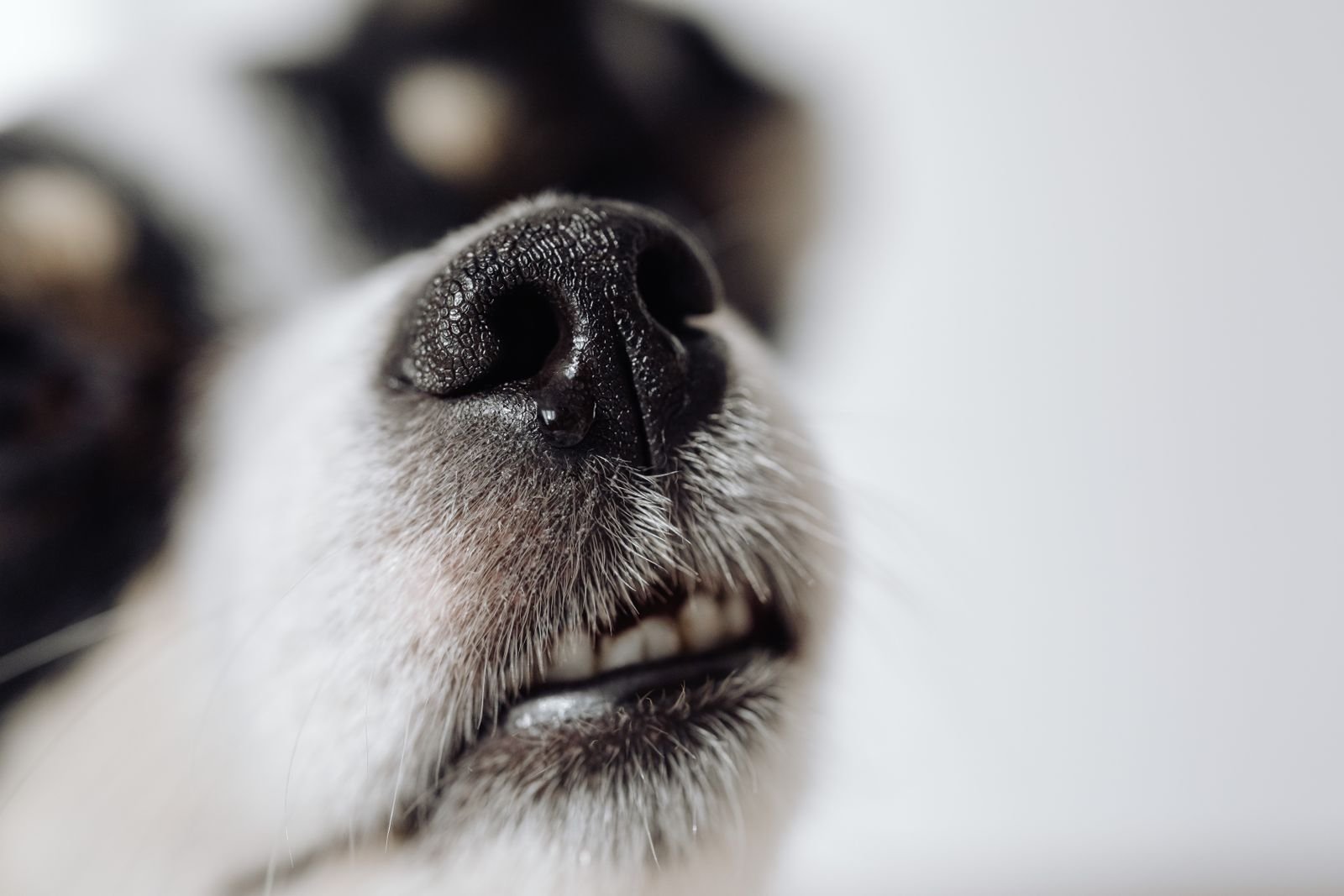
A Wet Nose Is Working Equipment, Not a Health Certificate
Somewhere along the way, dog owners inherited a piece of folk wisdom: wet nose means healthy dog, dry nose means call the vet. It is repeated with total confidence and it is not true. A dog can be seriously ill with a slick, cold nose, and a perfectly healthy dog can wake up from a nap with a nose like warm suede.
What is true is that the wetness is doing a job, and once you know what the job is, both the moisture and its absence stop being mysterious.
Where the Moisture Actually Comes From
Three sources, running more or less constantly.
The first is internal. Glands in the nasal lining secrete a thin layer of mucus that seeps forward onto the outside of the nose. This is not incidental leakage; it is a continuous, maintained film.
The second is the tongue. Dogs lick their noses dozens of times an hour, often without any obvious trigger. Partly this keeps the surface clean, since a nose that spends its day pressed into grass, bins, and other dogs collects a lot of debris. But the licking has a second function that matters more, and we will come back to it.
The third is simply the world. Your dog investigates by shoving his face into damp grass, wet leaves, puddles, other animals, and the underside of shrubs. A dog who has been outside for ten minutes on a normal morning has a wet nose whether or not his glands did anything.
Why Wetness Makes a Dog Smell Better
This is the part that makes the whole system make sense. Odour is not a wave that travels through the air like sound. It is physical molecules, drifting, and a nose can only detect a molecule it manages to capture.
A dry surface is bad at capturing molecules. A moist one is very good at it. The mucus film traps scent particles as air moves across it, dissolves them, and holds them against the sensory tissue long enough to be read properly. Dogs carry well over a hundred million scent receptors, and estimates of their sensitivity run from a thousand to ten thousand times ours. That machinery still needs its samples delivered wet.
Then the licking comes back into it. When a dog licks his nose, he is transferring dissolved scent molecules to the roof of his mouth, where a second chemical-sensing structure sits, the vomeronasal organ, also called Jacobson’s organ. It handles a category of chemical information the main olfactory system does not, particularly the social and hormonal signals dogs leave for each other. That absent-minded nose lick after sniffing a lamppost is a dog moving a sample from one instrument to another.
The Cooling System
Dogs do not sweat across their skin the way you do. They shed heat by panting, a little through the paw pads, and partly through the nose. Watery secretion on the nasal surface evaporates, and evaporation removes heat.
It is a modest contribution rather than the main event, but it is real, and it explains why the nose is often wettest when a dog is warm and working. It also means a nose that is dry and warm after a hot afternoon or a hard run is not a symptom. It is a system that has been spending its moisture.
So When Is a Dry Nose Nothing?
Most of the time. Dogs routinely have dry noses after sleeping, because they were not licking for two hours. Also in dry indoor air, near a radiator or air conditioner, after exercise, in cold wind, and in older dogs whose secretions have simply thinned with age. Some individual dogs run drier than others their whole lives, and some breeds with short muzzles cannot reach their own noses comfortably, so they lick less.
None of that is a reason to worry. A dry nose on its own tells you nothing about a dog’s health, and using it as a screening test mostly produces false alarms and, worse, false reassurance.
When It Is Worth a Phone Call
Stop watching the moisture and start watching the tissue and the dog.
Book an appointment for thick discharge, particularly if it is green or yellow, or if it comes from only one nostril, which often points to something lodged up there. Blood is always worth a call. So is a nose that has gone crusty, cracked, ulcerated, or lost its pigment, since those can indicate autoimmune disease, and so is persistent pawing or rubbing at the face.
The most important signal is the one that has nothing to do with the nose. A dry nose on a dog who is eating, playing, and behaving normally is a dry nose. A dry nose on a dog who is lethargic, off his food, or otherwise not himself is not the problem, it is a detail next to the problem, and the vet needs to hear about the rest of it.
The Short Version
Your dog’s nose is wet because a moist surface catches scent, because he licks it constantly to sample and clean it, because he keeps pushing it into damp things, and because a little evaporation helps him stay cool. It is a working surface on the most important sensory organ he owns.
It is not a thermometer. Judge his health by his appetite, energy, and behaviour, and let the nose get on with its actual job.