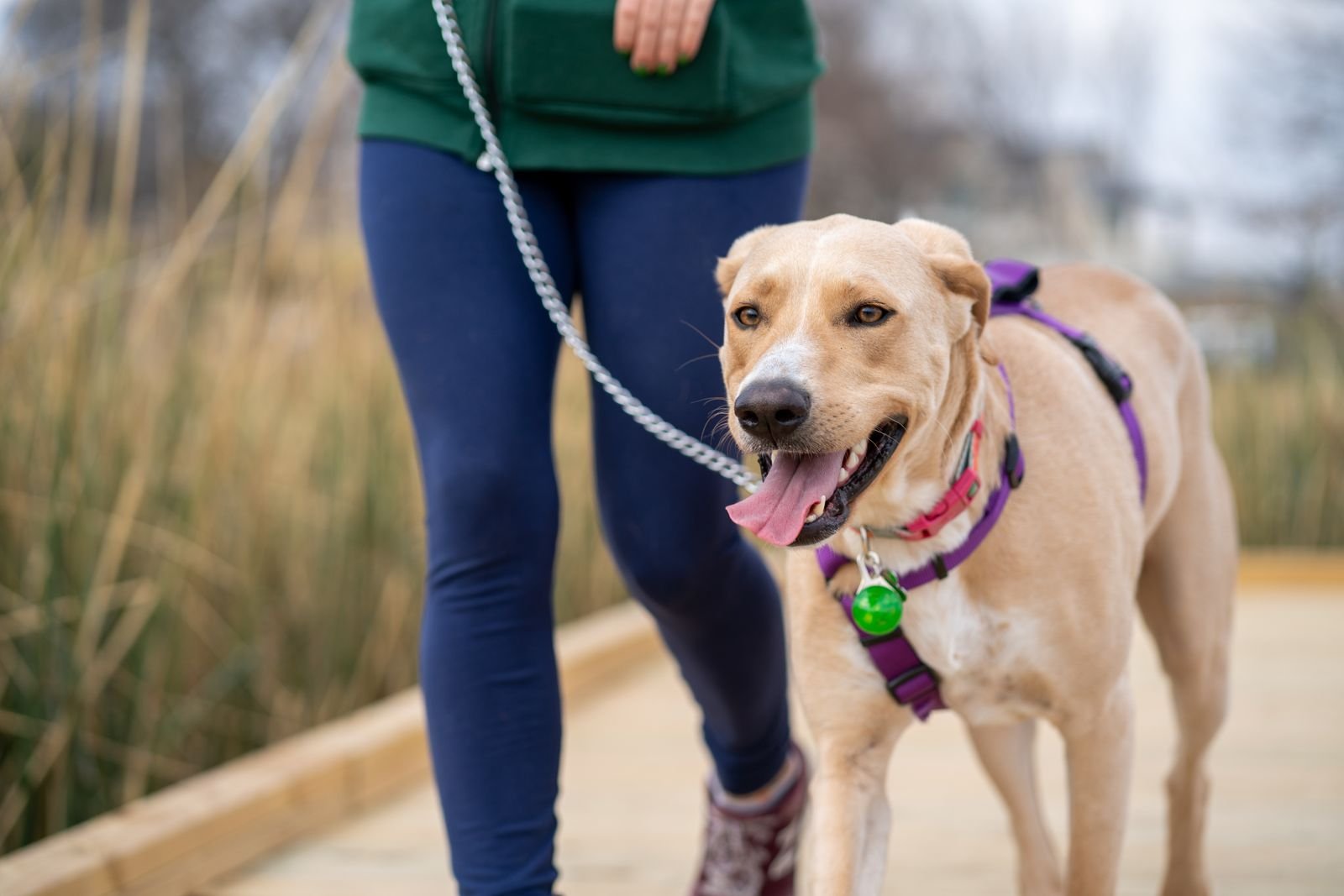
Pulling Works, and That Is Exactly Why It Continues
Your dog is not pulling because he is stubborn, dominant, or making some point about who runs the household. He is pulling because it works. He leans into the harness, the mailbox gets closer, and the world confirms what he already suspected: forward pressure produces forward motion. Every walk the two of you have ever taken has quietly paid him for it.
That is the whole mechanism, and it changes what you do next. If pulling has been rewarded a few thousand times, no amount of scolding is going to out-argue that history. The only thing that reliably undoes the habit is making the payment stop arriving.
So the fix is not a trick. It is a policy. Tight leash, nothing happens. Loose leash, the walk continues. Your dog does not need to understand that rule in English. He needs to bump into it often enough that his own math changes.
Stop, Wait, and Let Him Do the Arithmetic
The method is almost insultingly simple. The second the leash goes tight, you stop walking. No jerk, no correction, no lecture — you just become a tree. Sooner or later your dog looks back, shifts his weight, or eases off the tension because straining at the end of a rope is genuinely boring. The instant the leash softens, you walk on again.
The walk itself is the paycheck. You are not withholding it forever, you are putting it on a condition.
A few things make this go faster:
- Be boringly consistent. If you stop nine times and let the tenth pull slide, you have taught him that pulling sometimes pays, which is the most durable lesson in behavior.
- Say something the moment the leash goes slack. A quick “yes” and a small treat marks the exact half-second you want repeated.
- Change direction now and then. Turning and walking the other way keeps him checking in with you instead of towing you toward a fixed destination.
- Let sniffing be the reward. Reaching the good hedge on a loose leash is a real, dog-sized prize. Use it.
Consistency beats intensity every time. Ten calm stops beat one dramatic correction, because the stops are teaching a rule while the correction is only teaching that you are occasionally alarming.
Your Gear Is Either Helping or Quietly Coaching Him
Equipment will not train your dog, but it can stop working against you. A flat collar puts the leash on the back of the neck, where a dog’s body is built to push into pressure — the same reason sled dogs wear a harness. A front-clip harness moves the attachment point to the chest, so a hard pull turns him gently back toward you instead of driving him forward. It teaches nothing on its own — it just takes the horsepower out of the habit while the real learning happens.
Retractable leashes do the opposite. They apply constant light tension and reward every inch of forward pressure with more line — a very efficient way to train the exact thing you are trying to undo. A plain six-foot leash gives you an honest signal instead: tight or slack, no negotiating.
If your dog is large, strong, or already coughing against a collar, have your vet or a trainer check your setup in person.
The First Few Weeks Will Be Short and Dull
Here is the part nobody puts on the box. If you do this properly, your early walks will barely be walks. You will spend twenty minutes covering half a block, stopping every few steps, feeling faintly ridiculous. That is not the method failing. That is the method working, out loud, in real time.
Plan for it. Pick a quiet street instead of the exciting one. Go out with the goal of practicing rather than covering distance, and drain some energy another way first so the walk is not his only outlet. Progress will be uneven, too. A dog who is lovely on Tuesday can forget everything on Saturday when there is a squirrel involved.
But somewhere in the third or fourth week, you will notice you have gone a whole block without thinking about the leash at all. It stays slack, he checks in without being asked, and the walk starts to feel like something you are doing together instead of a tug-of-war with a deadline. That quiet, unremarkable stretch of sidewalk is the entire goal.